Assembly hearing on the human case
Gate CrashersThe Assembly hearing on the human case is the story’s central confrontation between human survival and interstellar authority. Convened after the destruction of Culpus-Alam, Okim, and Kulla, it places Allison Ridgeway and her companions before representatives who treat the humans as suspected geocides while D’armic petitions for a fuller investigation. The hearing does not immediately deliver justice: it confirms that the case against the humans is structurally compromised, yet also reveals that the punitive expedition against Earth has already been dispatched. Its decisive irony is that truth becomes visible only after official procedure has made catastrophe difficult to stop.
Setting and Participants
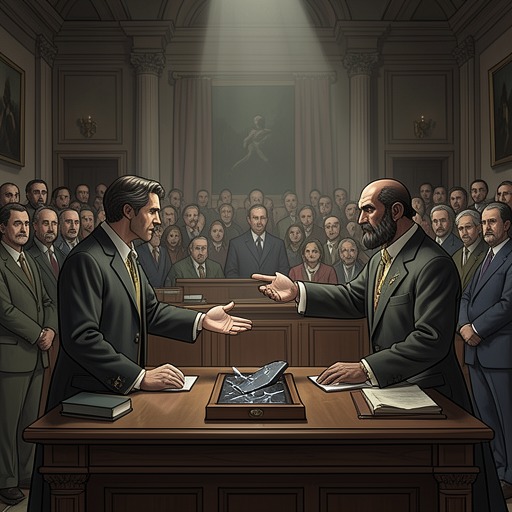
The hearing takes place at the Assembly’s seat, where Allison Ridgeway, Felix Fletcher, and Jacqueline Dorsett confront an institution whose traditions are literally engraved into its monumental doors. Maximus Tiberius and Thomas Harris assess the guards for weaknesses while the others absorb the historical weight of the setting, establishing two simultaneous dimensions of the encounter: a ceremonial tribunal and a potentially hostile security operation. The Assembly’s representative is Bloon, an elder Lividite in elaborate office vestments. Before the petition begins, Bloon warns D’armic that the Turemok representative has moved to censure D’armic’s codefendants. The measure receives three votes for and three against, so it fails. This narrow procedural result matters because the humans are not yet formally silenced, but neither are they secure; their ability to speak depends on a balance that could easily have gone the other way. The legal dispute is also complicated by names and jurisdiction. When Allison refers to Solonis B, Bloon asks what that is, and D’armic explains that humans call Culpus-Alam by another name. Bloon then insists that Culpus-Alam was an Assembly world and therefore falls under Assembly jurisdiction. The hearing consequently concerns more than the identity of the destroyer: it establishes who has the authority to define the planet, prosecute its destruction, and decide whether humans possess any standing in the matter.
The Petition and the Physical Evidence
Allison’s petition is not a request to negotiate the release of prisoners. She states that its purpose is to stop retaliation against Earth, because the human party possesses evidence that exonerates it and demonstrates that it was framed. D’armic supports her claim, explaining that the evidence is physical and that he has personally examined it. His testimony is important precisely because he stands accused as a coconspirator; the Fenax representative can dismiss his defense as self-interest, but cannot erase the material fact on which it rests. The crucial technical argument concerns the Bucephalus. D’armic states that the human vessel is physically incapable of creating high-space portals large enough to destroy Culpus-Alam, Okim, and Kulla. Allison adds that the Magellan does not possess high-space technology either. The two ships therefore cannot account for the scale of the planetary destructions attributed to them. The prosecution’s narrative depends on treating human presence as proof of human capability, while the evidence separates the ships’ actual capacities from the crime assigned to them. D’armic identifies a more plausible source: the patrol cruiser commanded by the deceased Vel Noric. Ruckk reacts with disbelief, treating the suggestion that a Vel could have ordered geocide as absurd. D’armic answers that belief has no bearing on truth and points out that Ruckk’s earlier attempt to censure the defendants gives the Turemok representative a reason to suppress inconvenient evidence. The exchange converts the hearing from a simple defense against accusation into an inquiry into who benefits from the official version. Bloon then notices a possible gap in the argument: there are two human ships. The question forces Allison to clarify the vessels’ limitations rather than allowing the Assembly to dismiss the defense as incomplete. Her answer—that Magellan lacks high-space technology—makes the charge still less credible, while Bloon’s astonishment at sending a non-high-space-capable vessel so far from home reveals that the human expedition itself was dangerously improvised. The humans may be innocent of geocide without having acted prudently.
Procedure Against the Clock
The hearing’s most consequential revelation comes after Bloon accepts that the new evidence must be investigated. Even if the investigation confirms that Allison and D’armic are telling the truth, he says, the Assembly cannot halt the punitive expedition already authorized against Earth. The distinction between “would not” and “could not” exposes the violence hidden inside administrative procedure: the institution may recognize uncertainty and still be unable to reverse the machinery it has set in motion. The expedition was dispatched weeks earlier, after the destruction of Kulla was reported. By the time the hearing takes place, the legal process is therefore lagging behind military action. Allison responds that thirty billion people live on Earth and that destroying the planet despite evidence of human innocence would be monstrous. Maximus makes the same point through a catalogue of what the expeditionary crisis has already subjected the human party to: drowning, shooting, poisoning, explosions, crushing, burning, torture, and even being eaten. His bitter addition turns the hearing’s abstract vocabulary of retaliation into bodily experience. The temporal structure creates a fatal mismatch. Evidence moves at the speed of testimony, voting, and investigation; fleets move at the speed of prior authorization and military dispatch. The Assembly can reopen the question of guilt, but it cannot simply recall the armada. The hearing thus becomes a race between deliberation and irreversible force, with Earth’s population reduced to a deadline generated by someone else’s administrative decision.
Colonial Knowledge and the Meaning of Culpus-Alam
The hearing also reveals the larger history behind the planet at issue. Culpus-Alam was not an ordinary lost colony. Vel Noric had identified it as a controlled setting established many generations earlier to observe humans. Assembly races had taken isolated tribes from Earth, supplemented them with random samples to reduce inbreeding, and placed them on the planet as an anthropological experiment intended to model humanity’s response to unfamiliar cultures. The experiment’s subjects developed distinct societies without knowing that they were being watched. The Pirikura, for example, maintained their own language, hospitality, sacred prohibitions, bodily customs, and explanations of gravity. Their territory included the forbidden Cave of the Creators, a place believed to shelter sleeping gods and guarded by phantoms or monsters. A young Pirikura named Tolo, who had no ears, knew a route by which he had escaped the supposed monsters but refused to return. Human investigators such as Allison and Felix approached these people as explorers, yet the larger revelation recasts the entire encounter: the humans on Culpus-Alam were themselves displaced, isolated, named, and observed by a civilization claiming scientific authority. The Assembly created the experiment because its broadcasts offered contradictory images of humanity as noble and tolerant on one hand, irrational, violent, and bigoted on the other. Unable to decide which representation was accurate, it built a living model. This rationale is both methodical and accusatory. It treats a population as a test system and turns uncertainty about a civilization into permission to remove people from their home world. The hearing’s jurisdictional claim over Culpus-Alam therefore rests on the same authority that first transformed human communities into research material.
Consequences and Narrative Significance
The hearing does not end with acquittal, recall, or safety. Its immediate result is narrower but momentous: Bloon agrees that the new physical evidence must be investigated, while warning that the punitive expedition against Earth cannot yet be stopped. The humans gain recognition that their account is technically credible, but they remain exposed to the consequences of a decision made before their evidence could be heard. The event brings together several forms of power that the wider story has kept apart. Scientific observation produced the hidden history of Culpus-Alam; military force destroyed worlds and dispatched an armada; legal procedure now attempts to sort responsibility after the fact. The hearing makes those systems visible as a single chain. Humans were first treated as objects of study, then as suspects, and finally as a planetary population threatened with punishment. Their movement through these categories shows how quickly the observer can become the observed and how easily an institution can convert uncertainty into violence. Its deepest significance lies in the contrast between formal balance and material inequality. A three-three vote can preserve the defendants’ right to speak, and a persuasive physical argument can expose the weakness of the accusation, yet neither procedural success guarantees survival. The Assembly can investigate truth only after the machinery of retaliation has acquired its own momentum. The hearing therefore functions not as a conventional courtroom resolution but as a revelation: the humans may be innocent, the official story may be false, and Earth may still be attacked because institutions act on conclusions that procedure has not yet had time to correct.